
Is dental care too expensive? The Canadian government might cover it for you.
If you’ve been putting off that dental checkup because of cost, here’s good news: the Canadian Dental Care Plan (CDCP) has expanded in 2026, and you might qualify for free or low-cost dental coverage—even if you’re retired or on a fixed income.
A single root canal in Canada can cost $500–$2,000+. A full set of dentures? $1,000–$8,000+.
Whether you need a routine cleaning, fillings, or even dentures, the CDCP could save you thousands of dollars every year. But many Canadians still don’t know they’re eligible.
In this guide, we’ll walk you through everything you need to know: who qualifies, what’s covered, and exactly how to apply in 2026.

1. What Is the Canadian Dental Care Plan (CDCP)?
The Canadian Dental Care Plan (CDCP) is a federal government program launched to provide dental insurance for Canadians who don’t have private coverage. It’s designed to remove financial barriers to oral health care, especially for low- and middle-income families, seniors, and individuals living on modest incomes.
Think of it as a safety net: if you don’t have dental benefits through your job or a family plan, the CDCP steps in to help cover essential dental services.
Unlike emergency-only programs, CDCP focuses on preventive and restorative care, which saves money long term.
2. Who Is Eligible in 2026? (Updated Criteria)
To qualify, you must meet all of the following conditions:

| Requirement | Details |
|---|---|
| No Private Insurance | You don’t have dental coverage through an employer, spouse’s plan, pension, or private insurance. |
| Income Limit | Your adjusted family net income must be less than $90,000 per year. |
| Residency | You must be a Canadian resident for tax purposes. |
| Tax Filing | You must have filed your tax return for the previous year. |
Are Seniors Prioritized?
Yes! If you’re 65 or older, you remain a priority group for the Canadian Dental Care Plan. This means:
- Faster application processing
- Priority access to coverage
- Simple renewal process—just keep your tax filings up to date each year
3. What Dental Services Does the CDCP Cover?
The Canadian Dental Care Plan covers a comprehensive range of dental services to help you maintain good oral health. Here’s what’s included:
| Category | What’s Included |
|---|---|
| Preventive Care | Professional cleaning (scaling), routine check-ups, fluoride treatments |
| Diagnostic | X-rays, oral examinations |
| Restorative | Fillings, crowns, root canals |
| Prosthetics | Removable dentures (partial or full) |
| Oral Surgery | Tooth extractions, minor surgical procedures |
What’s NOT Covered?
While the CDCP is generous, there are some limitations:
- Cosmetic procedures (teeth whitening, veneers)
- Orthodontics (braces) for adults in most cases
- Implants (coverage may be reviewed case-by-case)
- High-cost specialized services like night guards
4. How Much Does It Cost?
One of the best parts of the CDCP is that cost depends on your income—the less you earn, the less you pay.
Cost-Sharing Based on Income
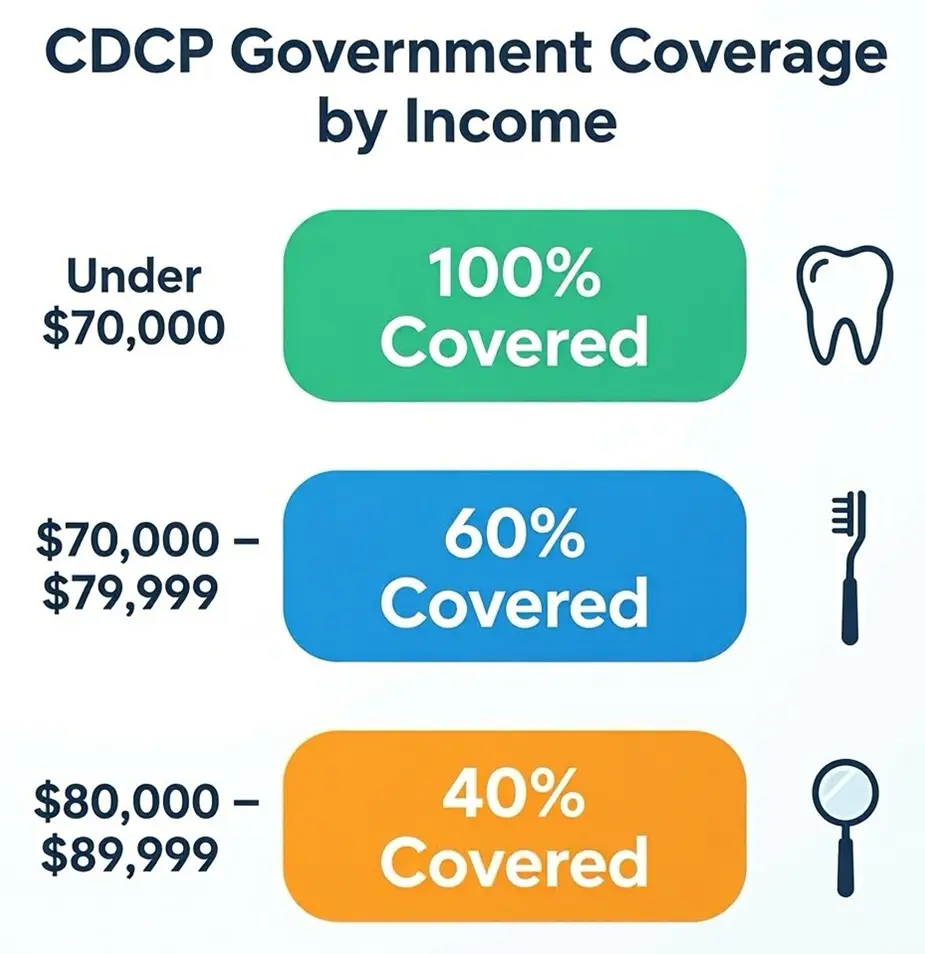
| Adjusted Family Net Income | Government Pays | You May Pay |
|---|---|---|
| Under $70,000 | 100% of eligible fees | $0 (in most cases) |
| $70,000–$79,999 | 60% | Partial co-payment |
| $80,000–$89,999 | 40% | Higher co-payment |
| $90,000+ | Not eligible | Full cost |
Important: Coverage details can vary depending on your income level. Lower-income households may receive more comprehensive coverage with lower or no co-pays.
Example: You earn $32,000 per year. You need 2 units of scaling ($145). The CDCP will pay: $134. Your Potential Out-of-Pocket Cost: $11.
Refer to Examples of co-payments and additional charges factsheet
5. How to Apply for CDCP (Step-by-Step Guide)
Applying for the Canadian Dental Care Plan is straightforward. Follow these four simple steps:
Step 1: Check Your Eligibility
Before applying, make sure you meet all the requirements:
- No private dental insurance
- Family income under $90,000
- Canadian resident for tax purposes
- Filed your most recent tax return
How to check your income: Look at Net Income (Line 23600) on your Notice of Assessment from the Canada Revenue Agency (CRA).
Step 2: Apply Through Service Canada
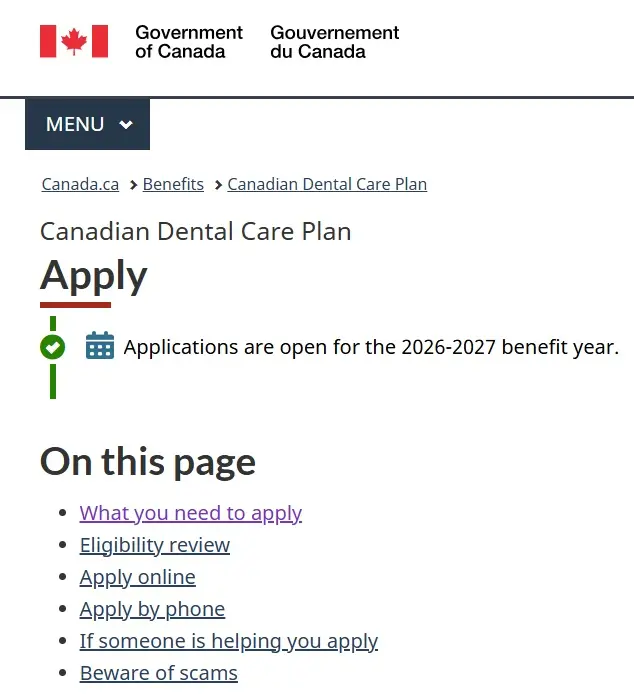
Applications are submitted through the official Government of Canada website. You’ll need:
- Your Social Insurance Number (SIN)
- Information from your latest tax return
- Contact information (email and phone number)
Prefer to apply by phone? Call Service Canada at 1-833-537-4342 (TTY: 1-833-677-6262).
Step 3: Receive Your Welcome Package
Once your application is approved, Sun Life (the program administrator) will send you:
- A member ID card
- Coverage details and benefit information
- Instructions on how to book appointments
Processing Time: Most applications are processed within 4–6 weeks.
Step 4: Visit a Participating Dentist
Find a dentist who accepts the CDCP. Many dental offices across Canada now participate in the program.
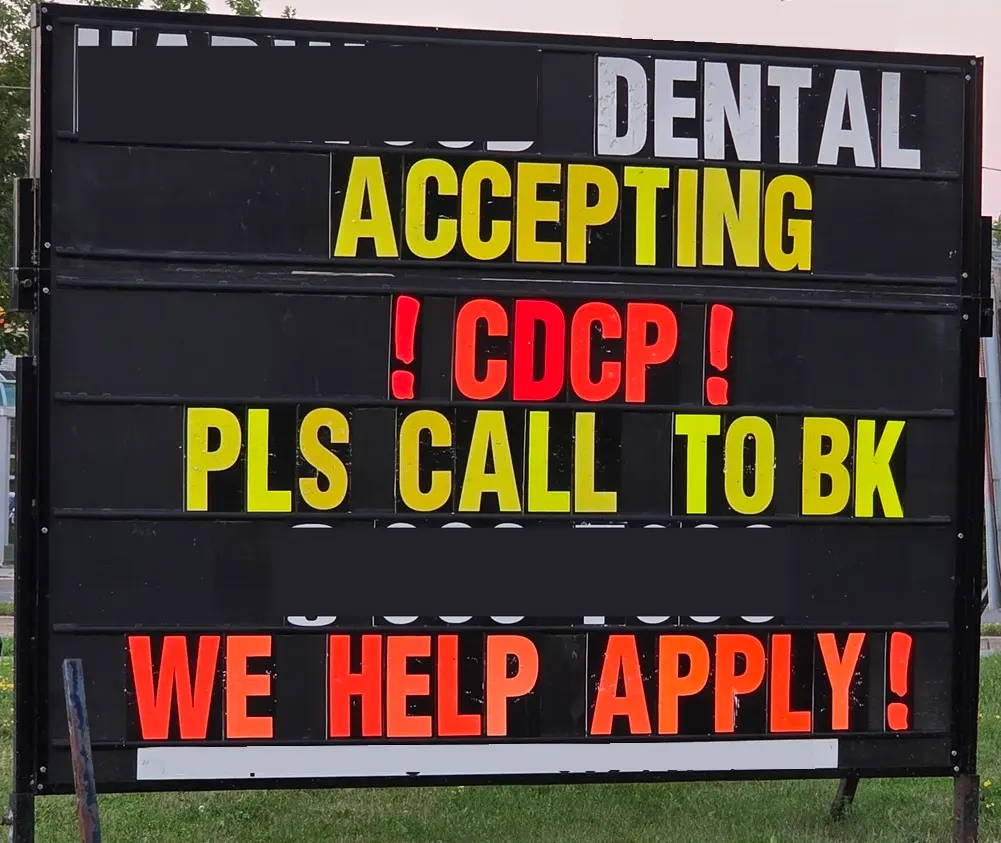
When you arrive:
- Present your CDCP member card
- The dentist will verify your coverage
- You’ll only pay your co-payment (if applicable)
Can’t find a participating dentist? Use the Sun Life provider search tool on their website or call their helpline at 1-888-888-8110.
6. Special Note for Seniors: Why the CDCP is Perfect for You
If you’re 65 or older, the CDCP is designed with you in mind. Here’s why it’s especially valuable:
Benefits for Seniors
- Priority enrollment: Seniors were among the first groups to gain access to the CDCP.
- No age-related restrictions: Unlike some private plans, the CDCP doesn’t limit coverage based on age.
- Coverage for dentures: Many seniors need dentures, and the CDCP covers both partial and complete dentures.
Common Questions from Seniors
Q: I already have a provincial dental program. Do I still qualify?
A: Yes! you can be covered by both, and benefits can be coordinated to reduce out-of-pocket costs.
Q: Do I have to reapply every year?
A: Yes, CDCP members are required to complete an annual renewal to confirm their eligibility.
Q: Will my dentist charge me more than the plan pays?
A: Yes, if your dentist charges more than the CDCP fee guide, you will be responsible for the difference.
Q: What if I am in the middle of treatment?
A: Coverage is based on the date the service is rendered, not when the treatment plan was created.
7. Frequently Asked Questions (FAQ)
Q: Does “no access to insurance” include opting out?
A: NO. if you choose to opt out of a plan offered by your employer or school, the government still considers you to have “access,” making you ineligible for the CDCP.
Q: What is “balance billing”?
A: Dentist may charge more than the “CDCP established fees.” You are responsible for paying this difference in addition to any co-payment.
Q: What if my income changes during the year?
A: The CDCP bases eligibility on your previous year’s tax return. If your income drops below $90,000 in the current year, you can apply based on next year’s tax filing.
Q: What happens if I move to a different province?
A: Your CDCP coverage follows you anywhere in Canada. You must update your address in your My Service Canada Account (MSCA) to ensure your file is current.
8. Final Thoughts: Don’t Wait—Your Dental Health Matters?
Dental problems don’t just affect your mouth—they can impact your overall health, including your heart, digestion, and quality of life. The good news? The Canadian Dental Care Plan makes it easier than ever to get the care you need without breaking the bank.
If you’re 65 or older, on a fixed income, or simply don’t have dental insurance through work, this program could save you thousands of dollars in dental costs every year.
📌Disclaimer
The information provided in this article is for general informational purposes only and does not constitute professional, financial, or medical advice. While every effort has been made to ensure accuracy at the time of publication, program details, eligibility criteria, and coverage terms may change without notice. Readers should verify all information directly with official Government of Canada sources before making decisions or applications related to the Canadian Dental Care Plan (CDCP). Late Bloomer WoW assumes no responsibility for any errors, omissions, or outcomes resulting from the use of this content.
Additional Resources
- Public Health Ontario, CDCP FAQ
- Sun Life Member CDCP FAQ
- Canadian Mental Health Association, CDCP FAQ
- Sun Life Member Services Portal, Sun Life Contact Centre at 1-888-888-8110
💡 Essential Canadian Senior Benefits You Shouldn’t Miss!
Along with the CDCP dental coverage, ensure you receive your full retirement benefits by checking our comprehensive guide on OAS (Old Age Security) Online Application. Learn about eligibility criteria and step-by-step submission.
👉 Read: How to Apply for OAS (Old Age Security) Online in Canada
🌏 한국어 버전으로 읽으시려면 [여기]를 클릭하세요.